Nepal Disaster Update Live coverage

Live coverage

Rasuwa flood: timeline

What happened and when, from the seismic signal recorded minutes before the river rose to the most recent bulletin, including how the death toll moved through the first two days.

Pieced together from Nepal Police bulletins, NDRRMA situation reports, local officials and named newsrooms. Times are Nepal time (NPT, UTC+05:45) and some are approximate. Where a source gives "morning" rather than a clock time, that is what is printed here rather than a guess.

Hour by hour

08:37 NPT, 26 August

Seismic stations register a signal near the Nepal-Tibet border. The USGS first logs it as a magnitude 4.4 earthquake. It later revises that assessment: the signal was a magnitude 5.2 glacial collapse, not a tectonic earthquake.

~09:00 NPT, 26 August

The Bhote Koshi rises suddenly where it crosses into Nepal. It was not raining in the Rasuwa catchment, so ordinary rainfall is ruled out as the cause.

Morning, 26 August

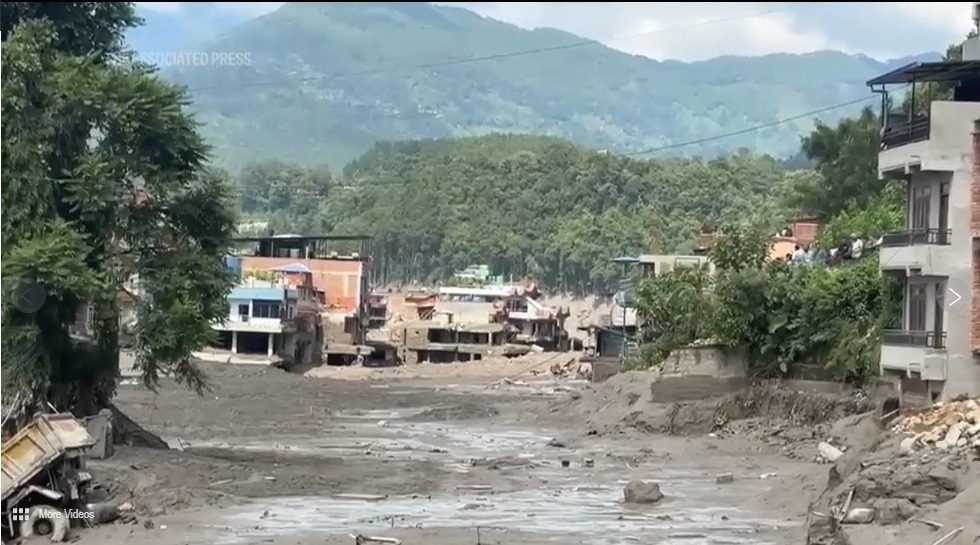
Timure, Syabrubesi, the Rasuwagadhi customs and border crossing and around a dozen riverside settlements in northern Rasuwa take the earliest and heaviest impact. Nine bank branches are swept away. The Syabrubesi helipad is destroyed, slowing rescue by air.

Through 26 August

The surge moves through Betrawati and Trishuli Bazar in Nuwakot, Galchhi and Dhunge Bazaar in Dhading, and past Muglin into the Narayani river system.

Evening, 26 August

Counts move fast and disagree: the Prime Minister’s Office reports 95 dead, NDRRMA 72, and by late evening around 160 with 157 bodies recovered. The government releases Rs 1 billion into the disaster relief fund. Physical Infrastructure Minister Sunil Lamsal puts road and bridge damage at about Rs 200 billion, and calls the figure preliminary.

08:15 NPT, 27 August

Nepal Police put the toll at 165 dead and list 826 people missing in Nepal, including 466 missing foreign travellers. Most were heading for the Kailash Mansarovar pilgrimage route through Tibet.

Morning, 27 August

China’s Ministry of Water Resources reports that a new barrier lake has formed upstream inside Tibet, near the confluence of the Chhochen Khola and the Purepu Tsangpo, holding around 2 million cubic metres of water. Chinese state media warn it could break.

13:30 NPT, 27 August

Nepal Police raise the toll to 270 as searches reach areas that had been cut off.

14:30 NPT, 27 August

Nepal Police put the confirmed toll at 289 dead. The Armed Police Force reports 121 bodies recovered from the Narayani alone. NDRRMA reports 113 people rescued, 88 of them Nepali citizens.

27 August, ongoing

The Nepal Electricity Authority puts hydropower damage at 14 projects and about 748 MW. The Department of Roads confirms the whole 42 km Betrawati-Rasuwagadhi road is destroyed at multiple points. India opens the Valmikinagar Barrage on the Gandak as a precaution and prepares to move 10,000 to 12,000 people downstream.

Where the water went, and when

The flood covered roughly 90 kilometres of river in a single day, dropping about 4,500 metres from the suspected break-off point to the furthest reported damage. That speed is the whole story of this event: it is why warning time was measured in minutes, and why the death toll is concentrated in the first two towns.

Ordered downstream. Coordinates for each point are on the map page.
PointElevationCountry / district
Glacial source area, Lende Khola headwaters~5,000 mChina (Tibet)
Lende Khola blockage~3,000 mChina (Tibet)
Rasuwagadhi / Gyirong border crossing~1,850 mNepal-China border
Timure~1,900 mRasuwa, Nepal
Syabrubesi~1,470 mRasuwa, Nepal
Betrawati~730 mRasuwa / Nuwakot boundary, Nepal
Devighat~460 mNuwakot, Nepal

See these points on the interactive map.

The response so far

UN OCHA situation overview, 27 August.
StrandWhat is happening
Search and rescueThe Nepali Army, Armed Police Force and Nepal Police are deployed with military and private helicopters. 113 people have been rescued so far, 88 Nepali citizens and 25 foreign nationals, from Timure, Dhunche, Syabrubesi, Uttargaya and Bidur.
Cabinet decisionsFree medical treatment for the injured, financial assistance to bereaved families, and orders to reopen roads, restore power and telecommunications, and provide food and shelter for the displaced.
International assistanceNepal has asked China and India for help. China has pledged relief funding; India is sending humanitarian supplies. The IFRC has released emergency funding to the Nepal Red Cross Society, which is distributing water, tarpaulins, blankets and first-aid supplies.
Downstream precautions in IndiaAuthorities in Bihar have opened the Valmikinagar Barrage on the Gandak, the same river that is called the Narayani inside Nepal, and prepared to evacuate 10,000 to 12,000 people.
What is still not knownNo government or humanitarian body has published a consolidated figure for people displaced, sheltering or in need. UN OCHA names that as the priority information gap for the days ahead.

What is still to come

Two things are unresolved as this page stands. First, the cause is not officially confirmed. The leading explanation is an ice-and-rock avalanche that blocked the Lhende Khola inside Tibet, and the USGS has reassessed the seismic signal recorded minutes before as a glacial collapse rather than an earthquake. The full account of what caused it sets out the evidence.

Second, the hazard has not ended. China reports a new barrier lake forming upstream holding around 2 million cubic metres of water, and warns it could break. Most river gauges on the Bhote Koshi and Trishuli were destroyed in the first wave, so any warning would come late. New entries are added to this timeline as bulletins are published.

Follow the live updates for anything published since the last entry above.