Nepal Disaster Update Live coverage

Live coverage

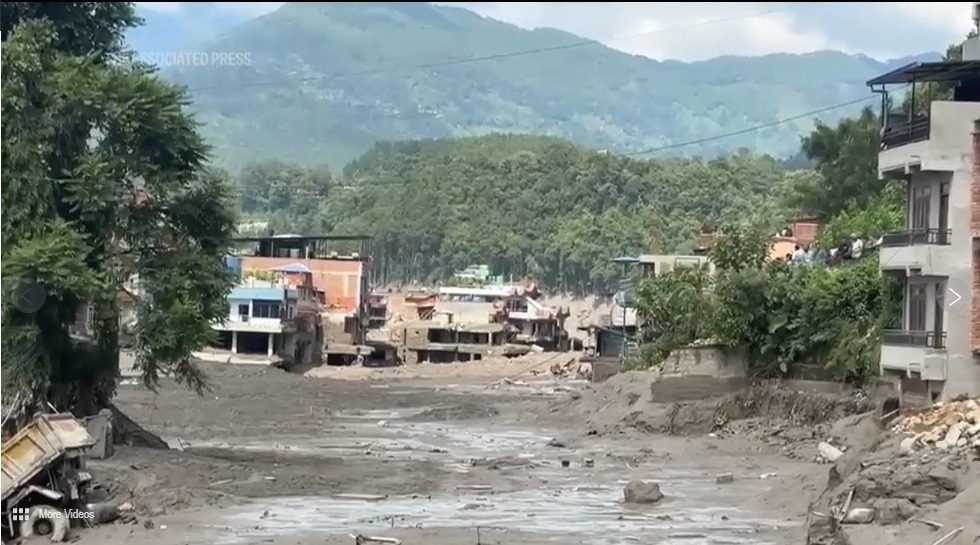
Hydropower damage from the Rasuwa flood

14 projects on the Bhote Koshi and Trishuli corridor were damaged, with about 748 MW of capacity affected. Here is the list and what it means.

The short version

14 projects hit. About 748 MW of capacity affected. The transmission substation that moves power off this corridor is damaged too, so the loss is larger than the sum of the plants.

What was damaged

The Nepal Electricity Authority reports 14 hydropower projects damaged along the Bhote Koshi and Trishuli corridor, with a combined capacity of about 748 MW. Of those, 9 were operating and generating, totalling 354 MW, and 5 were still under construction, totalling 394 MW.

Nepal Electricity Authority, reported through the UN OCHA situation overview, 27 August. Named projects only; the full count is 14.
ProjectDistrictWhat happened
Rasuwagadhi Hydropower ProjectRasuwaDamaged. Sits on the Bhote Koshi immediately below the border crossing.
Chilime HydropowerRasuwaDamaged. One of the country’s better-known community-shareholder projects.
Sanjen Khola HydropowerRasuwaDamaged, on a Bhote Koshi tributary.
Upper Trishuli-1Rasuwa / NuwakotDamaged. One of the largest projects on the corridor.
Upper Trishuli-3B substationNuwakot220 kV substation damaged, which affects evacuation of power from the whole corridor. Twelve project staff were reported out of contact.
Trishuli Hydropower StationNuwakotDamaged. One of Nepal’s oldest operating stations.
Devighat Hydropower StationNuwakotDamaged. The furthest downstream site where damage has been reported.

The substation matters more than it sounds

A damaged 220 kV substation is not one plant going offline. It is the road the electricity uses. Generation on that corridor that survived the flood may still not reach the grid until the substation is back, which is why the useful figure is the corridor total rather than any single plant.

Why the plants were where the water went

Almost all of these are run-of-river schemes. They need fall, which means a steep valley, and in a steep valley the powerhouse, the intake, the penstock and the access road all sit beside the river because there is no other flat ground. The same geography that makes the power cheap put every part of it in the path of the flood.

What this does to the wider picture

Nepal exports power to India in the wet season and imports in the dry season. Losing capacity in August, at the top of the wet season, hits the exporting half of that arrangement first. The rebuild timeline for a washed-out headworks in a valley whose access road no longer exists is measured in years, not months: the 42 km road from Betrawati to the border was destroyed at multiple points, and everything has to reach the site by that road eventually.

Common questions

How many hydropower projects were damaged in the Rasuwa flood?

The Nepal Electricity Authority reports 14 projects damaged, with a combined capacity of about 748 MW: 9 operating plants totalling 354 MW and 5 under construction totalling 394 MW.

Will there be load shedding in Nepal because of this?

The Nepal Electricity Authority has not announced scheduled load shedding as a result. Losing this much capacity at once puts real strain on supply, and a damaged 220 kV substation limits how much of the remaining generation on that corridor can be evacuated even where the plant itself survived. Watch the authority’s own notices rather than social media for this.

Why do so many of Nepal’s hydropower plants sit in the flood path?

Run-of-river schemes need a steep river, and a steep river in Nepal means a narrow valley. The powerhouse, the headworks and the access road all end up beside the water because there is nowhere else to put them. That is efficient in normal years and catastrophic in this kind of event.

Are the figures final?

No. An earlier estimate the same day, from the Ministry of Energy, put the loss at 431 MW. Both figures were published on 27 August 2026, which is a fair measure of how provisional every damage number is at this stage.