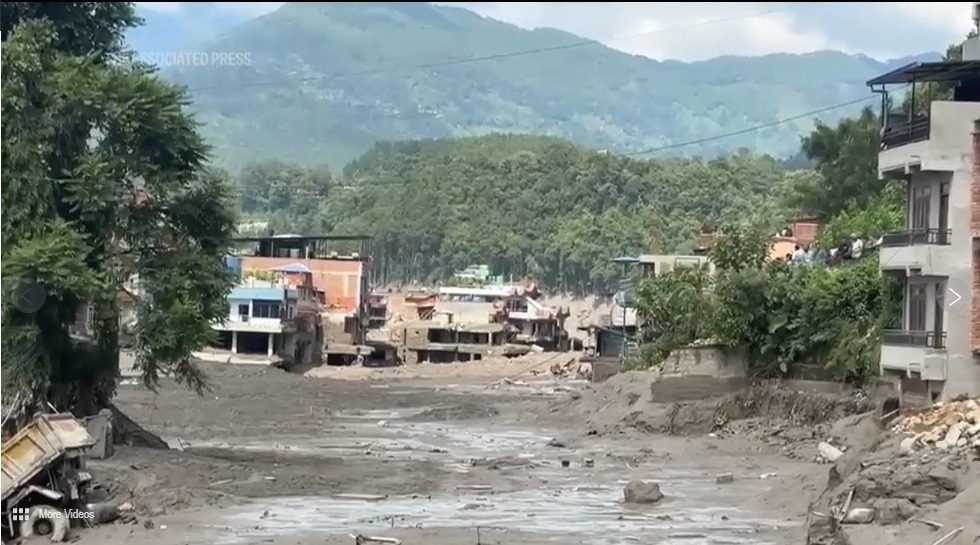
Landslides and debris flows in Nepal
The hazard that kills quietly, a few houses at a time, usually at night, usually in the monsoon, and almost always with no warning at all.
Nepal loses people to landslides every monsoon. They rarely make international news because each one takes a household or a hamlet rather than a town, but added together across a season they are one of the country’s largest causes of disaster deaths.
The mechanism is simple. Rain soaks into a steep slope. Water fills the spaces between soil particles, the friction holding the slope up drops, and a slab of hillside moves. On a slope with a stream in it the moving mass turns into a debris flow, which behaves like wet concrete travelling at the speed of a car and destroys anything in the channel.
Road building has made this worse across much of the hills. A road cut into a steep slope leaves a vertical face with nothing supporting it, and the spoil is usually pushed over the downhill side onto the slope below. Both the cut and the spoil fail in the first heavy monsoon. Many landslides in Nepal now start at a road.
Most landslide deaths happen between midnight and dawn, when it has been raining for hours and everyone is asleep indoors on a slope. That is why the practical advice is about where you sleep, not about what you do when you see one coming.
Warning signs
New cracks in the ground, in a yard, or in the walls of a house, especially cracks that widen over days.
Doors and windows that suddenly stick, or a floor that has started to slope.
Trees, poles or fence posts leaning downhill when they did not before.
Water appearing where it never has, or a spring going dry.
A rumbling that grows louder. If you hear that, you have seconds.
What to do
Move sideways off the path of the slope, across the hill, not straight downhill. You cannot outrun a debris flow going down its own channel.
If you are indoors on a slope at night during prolonged heavy rain, sleep on the uphill side of the house, or move the household to a neighbour on flatter ground.
Do not shelter in a gully, a stream bed or below a fresh road cut.
After a landslide, do not walk onto the debris to look or to help until it has been assessed. Slides usually come in more than one movement.
If a landslide has blocked a river, get downstream residents warned. A blocked river forms a lake and that lake will break.
Where Nepal stands
Road-cutting on steep terrain has made this worse in many districts, because the cut face is the first thing to fail.
Common questions
When are landslides most likely?
During and immediately after prolonged heavy rain, so mostly June to September, and disproportionately at night.
Is a slope that has already slipped safer now?
No. Ground that has moved once has lost strength and often moves again in the same season.
What is a debris flow?
A landslide that has picked up enough water to flow rather than slide. It travels much further and much faster than a dry slide and follows stream channels, which is why building in a gully mouth is dangerous even well away from the hill.
Emergency numbers
Police 100. Ambulance 102. Nepal's disaster hotline 1149. The full list, including district control rooms and embassies, is worth saving before you need it.
The other four hazards
- Glacial lake outburst flood (GLOF)A meltwater lake high in the mountains breaks through the loose rock and ice holding it back, and empties down the valley at once
- EarthquakesIndia is pushing under Asia at about 2 cm a year
- Monsoon river floodsJune to September brings most of Nepal’s yearly rain
- Fire, lightning and cold wavesLess talked about, still deadly