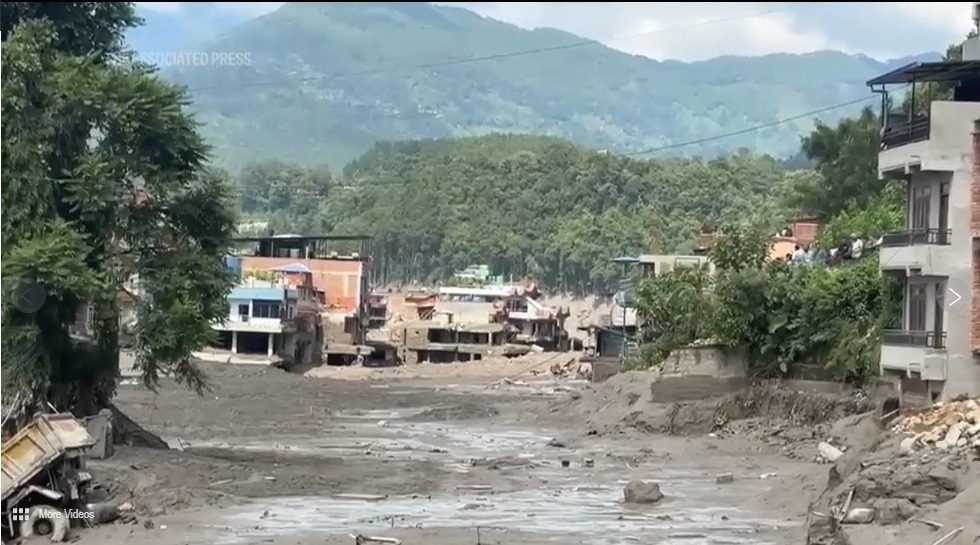
Glacial lake outburst floods in Nepal
The hazard behind the 2026 Rasuwa flood. A lake that nobody lives near empties in an afternoon and kills people fifty kilometres downstream.
A glacier melts. The meltwater collects behind the loose rock and dead ice the glacier left when it retreated. That rubble is not a dam. Nobody built it and nothing holds it together but friction, and it sits at the top of a valley with a river running out of the bottom of it.
Sooner or later something disturbs it. An ice avalanche falls into the lake and pushes a wave over the rim. A rock slope collapses and blocks the river instead, ponds a new lake in hours, and then that gives way. Warm weeks melt the ice core out of the rubble and the wall slumps. In every version the ending is the same: the whole lake leaves at once.
What comes down the valley is not water. It is water carrying boulders, gravel, trees and everything the flood has already destroyed, moving fast enough to take out a concrete bridge. That is why a glacial flood can be far more destructive than a monsoon flood carrying the same volume of water.
Nepal is unusually exposed to this. Its rivers start in ice, its valleys are steep, and its settlements, roads, border crossings and hydropower plants are all built along the river because in that terrain there is nowhere else flat. More than twenty glacial lakes inside Nepal are classified as potentially dangerous. Many more sit across the border in Tibet, on rivers that flow into Nepal, where Nepal has no gauges and no sirens and depends on Chinese authorities passing a warning on.
The warning time is the whole problem. From a lake bursting to the water arriving can be under an hour. In the 2026 Rasuwa flood most of the river gauges that existed downstream were destroyed by the first wave, so any second surge would arrive with even less notice than the first.
Warning signs
The river rises fast on a day with no rain where you are. Rain upstream, or none at all, does not matter; the water is coming from ice.
The river suddenly drops or stops. That means something upstream is holding it back, and whatever is holding it back will fail.
A roar or a rumble from upstream that keeps growing. People who have survived one describe it as sounding like a jet, not like water.
The water turns grey, brown or black and starts carrying wood and rubbish.
What to do
Go uphill, straight away, and keep going past where you think is far enough. Height beats distance.
Do not go along the road. Roads follow rivers, which is exactly where the water goes.
Do not go back for belongings, animals or a vehicle. The first wave is rarely the biggest.
Do not stand on a bridge to watch. Bridges are the first thing to go.
Once you are high and safe, stay there until officials say it is over, not until the river looks calm.
Where Nepal stands
More than 20 glacial lakes in Nepal are classified as potentially dangerous, and many more sit across the border in Tibet where Nepal has no monitoring. This is the hazard behind the 2026 Rasuwa flood.
Common questions
Is a glacial lake outburst flood caused by an earthquake?
Usually not. Shaking can trigger the rock or ice fall that starts one, and a seismic station will record the collapse itself, which is why these events are sometimes first reported as earthquakes and corrected later. That is exactly what happened in Rasuwa in August 2026, where the US Geological Survey first logged an earthquake and then reassessed the signal as a glacial collapse.
How much warning is there?
Sometimes an hour, often less. Where the lake is across an international border there may be none at all until the river itself tells you.
Are they getting more common?
Yes. Himalayan ice is melting faster than it is replaced, so there are more lakes, they are bigger, and the rubble holding them back is weaker. ICIMOD, the regional research centre for the Hindu Kush Himalaya, describes cascading glacial hazards as increasing at an unprecedented pace.
Can they be predicted?
Individual lakes can be monitored by satellite and some have sensors and sirens. Predicting the day one bursts is not currently possible. Lowering a dangerous lake by draining part of it has been done in Nepal, at Tsho Rolpa, and it is slow and expensive.
Emergency numbers
Police 100. Ambulance 102. Nepal's disaster hotline 1149. The full list, including district control rooms and embassies, is worth saving before you need it.
The other four hazards
- EarthquakesIndia is pushing under Asia at about 2 cm a year
- Landslides and debris flowsSteep slopes, heavy rain and cut roads together cause a large share of Nepal’s monsoon deaths every year, usually at night and usually with no warning
- Monsoon river floodsJune to September brings most of Nepal’s yearly rain
- Fire, lightning and cold wavesLess talked about, still deadly