Earthquakes in Nepal
The Indian plate is pushing under Asia and the Himalaya is what that collision looks like. The shaking is the strain being released.
India moves north into Asia at roughly two centimetres a year. The rock does not slide smoothly. It locks, strain builds for decades or centuries, and then a section releases in seconds. That release is an earthquake, and the mountains above it exist because this has been going on for tens of millions of years.
The 2015 Gorkha earthquake killed nearly nine thousand people and destroyed or damaged hundreds of thousands of buildings. Seismologists are clear that it did not release all the accumulated strain along the Himalayan front, and that western Nepal in particular has not had a great earthquake in a very long time.
Most people are not killed by the ground moving. They are killed by what the ground moving brings down: unreinforced masonry walls, heavy roofs on weak columns, parapets, water tanks and the outsides of buildings falling into the street people have just run into.
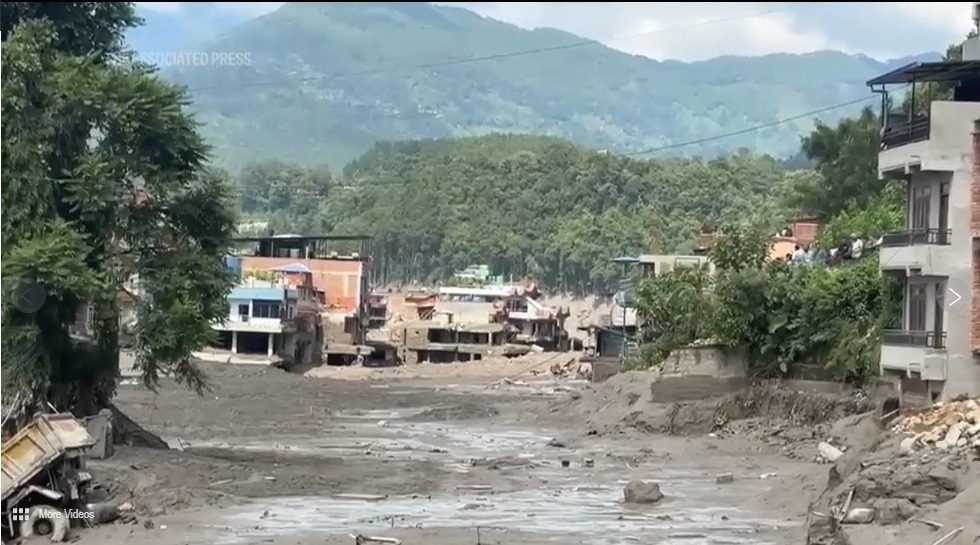
The hours after a large quake carry their own hazards. Aftershocks continue for weeks and can bring down buildings that survived the main shock. Slopes loosened by the shaking fail in the next rain, sometimes months later. Rivers get blocked by landslides and then break through.
Warning signs
There is no reliable warning before an earthquake. Treat any shaking as the real thing from the first second rather than waiting to see if it grows.
Some people feel or hear a low rumble a second or two before the strong shaking. That is not enough time to leave a building. It is enough time to get under something.
What to do
Drop, cover and hold on. Get under a sturdy table or against an interior wall, away from windows and away from anything heavy that can fall on you.
Do not run outside during the shaking. The street next to a building is one of the more dangerous places to be.
If you are in bed, stay there and protect your head with a pillow, unless there is something heavy directly above you.
If you are outdoors, get into an open space away from buildings, walls and power lines and stay there.
After it stops: check for injuries, turn off gas if you smell it, expect aftershocks, and stay out of damaged buildings even if they look standing.
Avoid steep slopes and riverbanks for days afterwards. Shaking loosens both.
Where Nepal stands
Expect aftershocks for weeks. Avoid damaged buildings, steep slopes and riverbanks afterwards; a quake loosens both.
Common questions
Is it safe to go back into my house after an earthquake?
Not until someone competent has looked at it. Cracks through structural walls, a leaning frame, or a floor that has dropped at one end all mean stay out. Aftershocks finish off buildings that the first shock only weakened.
How long do aftershocks last?
Weeks to months after a large earthquake, getting less frequent but not stopping neatly. A large aftershock is possible days later.
Does a small earthquake release pressure and prevent a big one?
No. The energy scale is such that it would take an enormous number of small earthquakes to release the strain of one large one.
Emergency numbers
Police 100. Ambulance 102. Nepal's disaster hotline 1149. The full list, including district control rooms and embassies, is worth saving before you need it.
The other four hazards
- Glacial lake outburst flood (GLOF)A meltwater lake high in the mountains breaks through the loose rock and ice holding it back, and empties down the valley at once
- Landslides and debris flowsSteep slopes, heavy rain and cut roads together cause a large share of Nepal’s monsoon deaths every year, usually at night and usually with no warning
- Monsoon river floodsJune to September brings most of Nepal’s yearly rain
- Fire, lightning and cold wavesLess talked about, still deadly